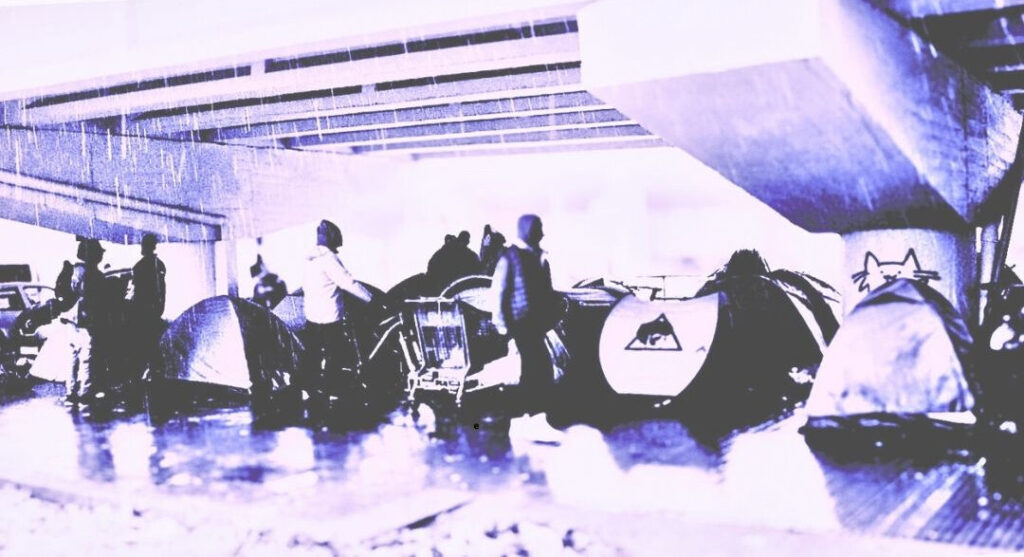
We all carried many different stories on our backs before we ended up living in the B9 warehouse. However, we all shared the same experience when asking for the most fundamental basic rights for living; because we are Black, neither landlords nor the state wanted to rent us an apartment or give us an employment contract. In other words, institutional racism has coerced us into a position in which it can profit from us and force us to do the most difficult work, whilst simultaneously barring us from having labour rights or access to the most basic good the state produces: housing.
Institutional racism manifests in many different ways in the housing sector. For instance, when a landlord notices your accent is different, sees that you are a Black person, or finds out where you were born, the property has suddenly already been reserved. Otherwise, they will impose absurdly high deposits that you cannot pay, or demand an employment contract that you cannot get because you do not have the proper documentation. Although the ways in which institutional racism operates are vast, both overtly and covertly, the conclusion is simple: if you are Black, you will be denied access to housing, the most basic human need to sustain and build a decent life.
The eviction of the B9 warehouse has exposed institutional racism in the most violent, urgent, and blatant way. But it affects, and always has affected, all aspects of life and society. For an African person, upon arrival to Catalonia, there are typically two options. If you have legal papers, you can work in the fields of Lleida picking fruit under inhumane conditions. If you are undocumented, the only legal work you can do is collect valuables from the trash. Under such working conditions, you have no rights. Even when you are sick or injured, you have no other option than to keep working. Everyone in B9 has held a decent job before; we were fishermen, teachers, carpenters, plumbers, drivers, artists, and soccer players, and to be completely honest with everyone, some people were police officers. Here, the state does not want us to use our skills; it does not want us to have dignified work and live as human beings. It wants us in a position where we do the hardest work without access to even the most basic needs.
They also keep us uninformed, criminalised, and disconnected from political movements so we cannot fight against this oppression. Social Services does not provide us with the information we need to complete the immigration process. They do not explain what you have to do to legalise your status or what rights you have. Even if you know how to regularise your status, they hold you back for many years with bureaucratic processes, which very often take you nowhere. While trying to obtain your empadronamiento*, they keep telling you that someone will be sent to perform the confirmation, but no one ever comes. Even if you manage to procure it, they somtimes simply delete your address registration without informing you or giving any explanation as to why they did it. Most times, the excuse they will give is that you made a mistake during the process, trying to blame you for doing things incorrectly.
But we know who is to blame. Institutional racism is not a flaw in the system or just another problem to manage: it is the foundation of a state and a society that needs racism to justify and construct oppression and inequality. It is consciously and intentionally designed to maintain the colonial and imperialist order. It is how the state classifies who is considered human and who is not.
To fight and defend ourselves against this system, we must support each other. We ask all organized communities to take responsibility for supporting us in meeting our basic needs. There are many people beyond the B9 who could be comrades in the struggle but are not because of the urgent hardship they face. To fight together, we must develop networks to ensure that everyone’s most basic needs are met. This is a first step in defending ourselves against the racist system that wants us silent and unable to express our experiences of oppression.
*In Spain, the empadronamiento is a document that is essentially an address registration. It is often required for legal processes, including those needed to obtain most other forms of documentation.